
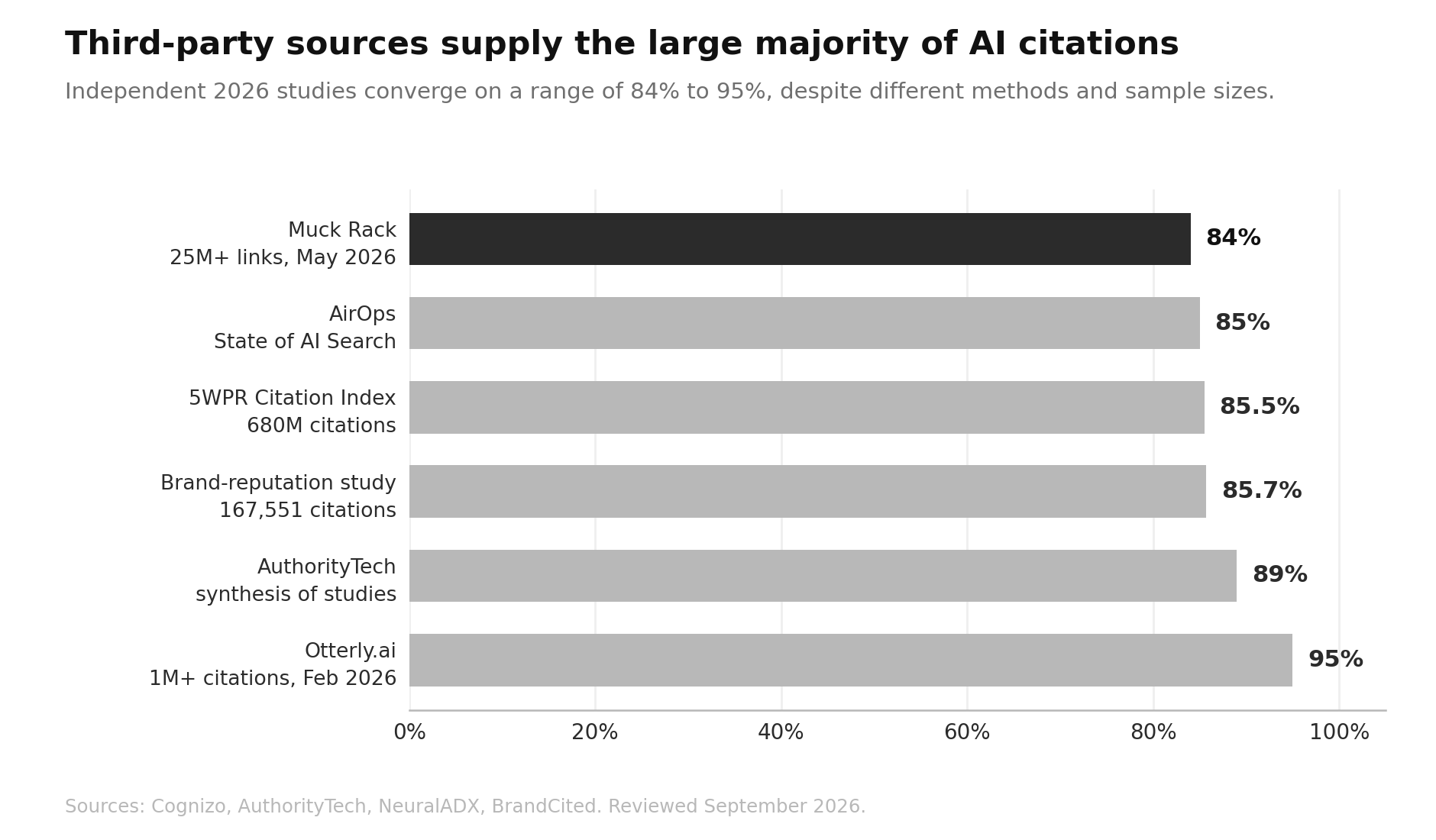
Analysis of more than 25 million cited links across ChatGPT, Claude, and Gemini found that earned, third-party media accounts for 84% of all AI citations, while paid and advertorial content accounts for just 0.3% (source: Cognizo).
Most GEO tools were designed to count brand mentions, which is a different measurement entirely: a mention tells you that a model said your name, while a citation tells you which page persuaded it.
That gap is why buyers now filter tools by whether they expose source-level data at all.
This review breaks down the GEO platforms that actually surface third-party citations in September 2026, what each one costs, where each one falls short, and which fits your team.
Key Takeaways
- Earned third-party sources account for 84% of AI citations across 25 million analysed links.
- Profound leads on source-level depth; Peec AI wins the price-to-depth ratio.
- Otterly.ai starts at $29 monthly, making citation monitoring viable for small teams.
- SEO suite add-ons cost less but expose fewer third-party source details.
- No tool earns citations for you; measurement and placement are separate disciplines.
Why Third-Party Citation Data Became the Buying Criterion
The concentration in AI citation sources is now the defining feature of the channel. The top 15 domains capture 68% of all consolidated AI citation share, and Reddit ranks first across every major platform at roughly 40% citation frequency (source: BrandCited).
A 2026 cross-market brand-reputation study found that 85.7% of its 167,551 URL-grounded citations were third-party, with roughly 80% of all citations coming from about 18% of domains (source: NeuralADX).
That distribution changes what a tool needs to do. If your own domain supplies a small minority of the sources behind AI answers about your category, a dashboard that only tracks whether your brand appeared is measuring the outcome and hiding the cause.
The useful question is which independent pages the engine pulled from, and whether you can influence them. We covered the platform-level version of this in our breakdown of which domains AI engines trust most.
Citation exposure is also growing rather than plateauing. Citation presence in US ChatGPT prompts rose from about 1.6% in June 2025 to roughly 6.8% by May 2026, reaching about 23% in travel and hospitality and under 4% in professional services (source: Similarweb).
The GEO Tool Market in September 2026
The category has money behind it.
AI visibility tools raised more than $300 million between summer 2025 and spring 2026, with Profound alone raising $155 million at a $1 billion valuation (source: Surmado).
Profound closed a $96 million Series C in February 2026 and reported more than 700 enterprise customers (source: Ayzeo).
Peec AI, the fastest-growing challenger, raised $29 million and passed $4 million ARR within ten months.
Demand followed. GEO went from a fringe term to a category drawing roughly 22,000 searches a month in 2026 (source: IndustryLens).
Pricing spread accordingly: entry access starts at $29 per month and runs to a $828 per month minimum for Ahrefs Brand Radar once the required base plan is included, with several vendors quoting custom enterprise pricing only (source: Otterly).
Engine share is shifting underneath all of it. Across March and April 2026, ChatGPT's share of measurable B2B AI referrals fell to 62.6%, with Claude at 18.5%, Gemini at 10.6%, and Perplexity at 7.3% (source: Goodie).
Single-engine tools age badly under that trend.
How We Reviewed These Tools
Every platform below was assessed on five criteria:
- Source-level citation output; Does it list the actual third-party URLs behind an answer, or only brand mention counts?
- Engine coverage at the entry tier, not the enterprise tier.
- Prompt allowance and per-prompt economics.
- Pricing transparency; including whether figures are published at all.
- Actionability; meaning whether citation data connects to work you can do next.
Pricing reflects publicly available information reviewed in early September 2026. This category revises pricing faster than it revises product, so verify during a trial.
If you want to validate any vendor's numbers independently, our guide to running a citation study without a research team covers the method.

The Best GEO Tools That Provide Third-Party Citations
1. Profound: Best for Enterprise Source-Level Citation Intelligence
Profound is the category leader and the deepest source-level product available. It organises prompts into topics and tags, then tracks how both brands and cited sources move across answer engines, with visibility, sentiment, positioning, and share-of-voice layered on top.
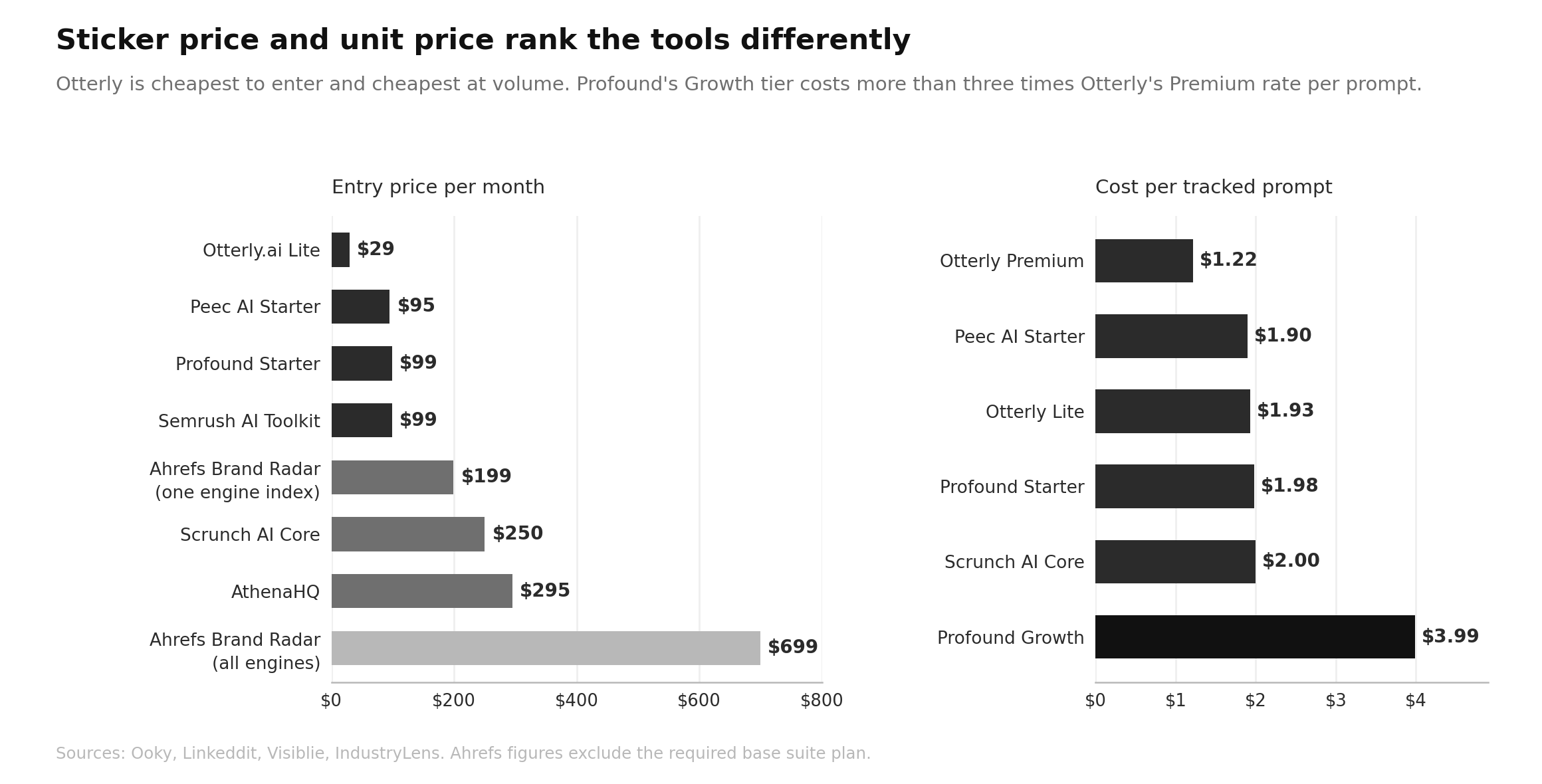
Pricing: $99 per month for Starter with 50 tracked prompts, $399 per month for Growth with 100 prompts, custom Enterprise (source: Linkeddit). Starter is annual-only billing.
Strengths: Coverage scales to ten engines, SOC 2 compliance, an agent action layer, and citation reporting granular enough to identify individual pages driving answers.
Limitations: The genuinely useful configuration usually sits above Starter, and the platform assumes analyst capacity to interpret it. Per prompt, Growth works out to roughly $3.99, the most expensive rate among published ladders.
Verdict: The right call if AI search is a funded programme with an owner. Overkill if it is a side project.
2. Peec AI: Best Value Citation Analytics for Mid-Market Teams
Peec AI delivers most of the analytics buyers actually use at a fraction of enterprise cost, which is why it has grown faster than anything else in the category.
Pricing: From €85 to €95 per month at Starter for 50 prompts with three or more models and unlimited seats, with a free trial (source: Visiblie). Enterprise reaches up to 11 LLMs.
Strengths: Unlimited seats at every tier, strong competitive brand positioning, daily tracking, and Looker Studio export.
Limitations: Peec renders no pricing to crawlers, which makes budgeting awkward before a sales conversation. It is strongest on brand perception and weakest on tactical, query-level citation detail, and there is no optimization layer.
Verdict: The best depth-to-price ratio for teams below enterprise scale.
3. Otterly.ai: Best Low-Cost Entry Point
Otterly is the most accessible serious tool in the market. Teams build prompt sets from real customer questions, and Otterly reruns them daily across ChatGPT, Google AI Overviews, AI Mode, and Perplexity, recording citations each time.
Pricing: Lite at $29, Standard at $189, Premium at $489 monthly, with Enterprise from $1,000 (source: Ooky). Premium works out to roughly $1.22 per prompt, the cheapest published rate at volume.
Strengths: Unlimited seats, daily reruns, and reporting that is more actionable than several newer platforms at four times the price.
Limitations: Fifteen prompts and four engines at entry make Lite a pilot rather than a programme. It relies on scraping rather than direct API partnerships, and there is no content or technical layer to act on findings.
Verdict: The correct first purchase for almost any team testing whether GEO deserves budget.
4. Scrunch AI: Best for Agencies and Multi-Seat Teams
Scrunch separates direct brand presence from mentions that appear only inside cited URLs or page titles, a distinction most competitors collapse. That separation is exactly what third-party citation analysis requires.
Pricing: Core at $250 per month with 125 prompts, four engines, and five user licences, including SOC 2 Type II and a seven-day trial (source: Visiblie). Enterprise extends to nine LLMs.
Strengths: Multi-seat access at mid-tier pricing, the widest native LLM coverage outside Profound Enterprise, and a data model built around source attribution.
Limitations: The engine-coverage jump between Core and Enterprise is steep. Optimization remains outside scope.
Verdict: Best structural fit for agencies managing several clients on one contract.
5. AthenaHQ: Best Mid-Tier Self-Serve Platform
AthenaHQ sits between the cheap monitors and the enterprise suites, with published pricing and a clean citation reporting model.
Pricing: Roughly $245 per month billed annually, or $295 per month billed monthly (source: IndustryLens).
Strengths: Transparent pricing in a category where transparency is uneven, solid citation source breakdowns, and a self-serve path that skips sales calls.
Limitations: Prompt allowances are moderate, and the platform competes directly with cheaper tools that publish comparable citation data.
Verdict: A dependable middle option, though Peec and Scrunch both undercut it on specific dimensions.
6. Semrush AI Toolkit: Best for Teams Already Inside Semrush
The toolkit tracks mentions, citations, sentiment, prompts, competitor gaps, and source patterns, with core coverage across ChatGPT, Perplexity, Gemini, Google AI Mode, and AI Overviews. Enterprise adds Claude, DeepSeek, and Grok.
Pricing: From $99 per month per domain as an add-on to an existing Semrush plan. Semrush was acquired by Adobe in April 2026 (source: Goodie).
Strengths: A large existing data network, easy activation for current subscribers, and llms.txt and structured data audits alongside prompt tracking.
Limitations: GEO modules remain visibility insight rather than deep optimization, and the roadmap under Adobe is still settling. Source detail is shallower than dedicated platforms.
Verdict: Reasonable if you already pay for the suite. Not a reason to start paying for it.
7. Ahrefs Brand Radar: Best for Cross-Referencing Citations With Link Data
Brand Radar is the broadest option at the top tier, and it uniquely lets you cross-reference AI citation sources against Ahrefs' backlink and mentions index.
Pricing: $199 per month per AI engine index, or $699 per month for all of them, on top of an Ahrefs suite plan (source: Linkeddit).
Strengths: Ahrefs analysed roughly 75,000 brands and found YouTube mentions correlated most strongly with AI visibility at 0.737 on the Spearman scale, with branded web mentions at 0.66 to 0.71 (source: AuthorityTech). That correlation work is native to the platform.
Limitations: The weakest AI-only value on this list once the base plan is counted, with no free trial and meaningful setup burden.
Verdict: Buy it for the link intelligence, not the citation tracking alone.
8. ZipTie and SE Ranking: Best Budget Suite Add-Ons
Both favour data quality and technical audits over breadth. ZipTie runs indexation audits that flag pages AI crawlers cannot reach, which is a real gap most visibility tools ignore. SE Ranking's AI Visible add-on runs $71.20 per month billed annually or $89 monthly for existing subscribers.
Limitations: Coverage stays limited to a handful of engines in both cases.
Verdict: Sensible bolt-ons. Neither replaces a dedicated citation platform.
Pricing at a Glance
| Tool | Entry price | Prompts at entry | Engines at entry | Citation source detail |
|---|---|---|---|---|
| Otterly.ai | $29/mo | 15 | 4 | Good |
| Semrush AI Toolkit | $99/mo per domain | Varies | 5 | Moderate |
| Profound | $99/mo (annual) | 50 | 1 at Starter | Excellent |
| Peec AI | €85 to €95/mo | 50 | 3+ | Strong |
| AthenaHQ | $245 to $295/mo | Moderate | 4+ | Strong |
| Scrunch AI | $250/mo | 125 | 4 | Excellent |
| Ahrefs Brand Radar | $199/mo per engine | High | 1 per index | Strong |
What Every Tool on This List Still Cannot Do
None of these platforms earns a citation. They tell you which third-party page an engine drew on, and stop there.
That boundary matters because the evidence on what moves citations points squarely at off-platform work.
Brands in the top 25% for web mentions earn 10 times more AI citations than lower-ranking competitors, and Seer Interactive documented a 75-fold multiplier between brands with active third-party signals and those without (source: Machine Relations).
When the same article was distributed across third-party publishers, AI citation rates rose from 7.6% to 34% under controlled conditions (source: BeaconSites).
Tools also miss the influence that never produces a click. When someone asks ChatGPT for a recommendation and searches your brand three days later, analytics logs a branded search visit and the AI recommendation gets no credit. Referral data tells you who sends clicks, not who mentions you.
Our breakdown of how to track AI search visibility covers how to reconcile the two.
Choosing by Budget and Team Shape
- Under $50 per month: Otterly.ai Lite. Enough to establish whether a gap exists before committing budget.
- $100 to $300 per month: Peec AI for analytics depth, Scrunch AI for multi-seat agency work, AthenaHQ for published pricing and self-serve onboarding.
- $400 and above: Profound Growth or Enterprise, provided someone owns the programme and can act on the output.
- Already on a suite: Semrush at $99 per domain or SE Ranking at $71.20 annually before considering a new vendor.
One caution on budget shape. Software should sit at roughly 5% to 15% of a mature GEO programme, with content and earned media consuming 50% to 70% (source: Ooky).
A team spending most of its budget on dashboards has inverted the ratio, a pattern we examined in our analysis of what GEO actually costs in 2026.
Conclusion
The tools reviewed here differ less on whether they report third-party citations and more on how deeply, at what price, and across how many engines.
Profound sets the ceiling on source-level depth.
Peec AI offers the strongest value below enterprise.
Otterly makes the category accessible at $29.
Scrunch handles multi-seat agency work best.
All of them stop at diagnosis.
With 84% of AI citations tracing to earned media and web mentions correlating with citation volume at a 10-fold multiple, the decisive work happens after the dashboard, in the third-party sources the engines already trust.
Read Next
- Should You Ask Your SEO Agency to Do GEO?
- Web3 Depends on AI Search More Than Any Sector
- What Your Side of a GEO Engagement Requires
FAQs
1. What are the best GEO tools that provide third-party citations in 2026?
The best GEO tools that provide third-party citations in 2026 are Profound for enterprise source-level depth, Peec AI for mid-market value, Otterly.ai for low-cost entry at $29 per month, and Scrunch AI for multi-seat agency teams. Each surfaces the actual third-party URLs behind AI answers rather than brand mention counts alone.
2. How much do GEO tools with citation tracking cost?
GEO tools with citation tracking cost between $29 and $828 per month at entry level, depending on whether a base suite plan is required. Otterly.ai starts at $29, Profound and Semrush at $99, Scrunch at $250, and Ahrefs Brand Radar reaches $828 once its required Ahrefs plan is included.
3. Why do AI engines cite third-party sources more than brand websites?
AI engines cite third-party sources more than brand websites because independent corroboration carries more evidential weight for contested claims. Analysis of 25 million cited links found earned media accounts for 84% of AI citations, and a 2026 study of 167,551 URL-grounded citations put the third-party share at 85.7%.
4. Can a GEO tool increase my AI citations directly?
A GEO tool cannot increase your AI citations directly, because measurement and placement are separate disciplines. Tools identify which third-party pages produce answers about your category; earning a place in those sources requires editorial coverage, review-platform presence, and distribution work that no dashboard performs on your behalf.
5. Which GEO tool is best for a small team starting out?
The best GEO tool for a small team starting out is Otterly.ai at $29 per month, which covers 15 prompts across four engines with unlimited seats and daily reruns. It provides roughly 70% of enterprise functionality at a fraction of the cost, making it suitable for validating whether a citation gap justifies further budget.
Prices, prompt allowances, and engine counts reflect publicly available vendor information reviewed in early September 2026; several vendors publish no figures at all, and those noted here come from independent comparisons rather than the vendor. Citation share statistics are drawn from studies with differing methodologies, sample sizes, and source taxonomies, so the ranges should be read as directional rather than exact.