
An analysis of 16,016 crypto prompts producing 230,398 citations across 7,857 domains found that 96% of crypto websites block AI crawlers. Meanwhile Google and Meta restrict crypto advertising, which removes the paid fallback most sectors rely on.
Those two facts sit badly together. The category with the least alternative distribution has the highest rate of excluding itself from the channel that replaced it.
For most industries AI visibility is a supplementary channel worth investing in. For Web3 it is frequently the only scalable organic route, and the first fix costs an afternoon.
Key Takeaways
- Crawler blocking is near-universal and usually accidental: inherited from security defaults, not chosen.
- There is no paid fallback: advertising restrictions make AI search a primary channel rather than an addition.
- Rendering compounds the problem: JavaScript-heavy sites are unreadable even when crawlers are allowed.
- Trust thresholds are higher: financial content faces stricter corroboration requirements.
- The first fix is immediate: access changes can show movement in weeks, unlike everything else.
Why the Blocking Happens
Almost none of it is a decision. Crypto sites run aggressive bot protection for good reasons: scraping, credential attacks, and automated abuse are constant. Default configurations on those services block broad categories of automated traffic, and AI crawlers land in the same bucket as everything else.
The result is that a protocol with excellent documentation, clear explanations, and genuine expertise can be entirely absent from the systems its users now research with, because a WAF rule set three years ago is doing exactly what it was configured to do.
Nobody in the organisation is likely to notice. Security owns the configuration, marketing owns the visibility problem, and the connection between them is rarely made until someone runs the check.
What Makes Web3 Structurally Different
| Factor | Most B2B sectors | Web3 |
|---|---|---|
| Paid channel fallback | Available | Restricted on major platforms |
| Crawler access | Usually open by default | Usually blocked by default |
| Site rendering | Mostly server-rendered | Frequently JavaScript-heavy |
| Category vocabulary | Established | Still forming, shifts quickly |
| Trust threshold | Standard | Elevated; financial content |
| Where discussion happens | Trade press, review platforms | Community platforms, Discord, X |
Every row makes the work harder, and the combination is why generic GEO advice underperforms in this sector. A programme built around review platform positioning and trade publication coverage is describing a media landscape that barely exists here.
The Rendering Problem
Allowing crawlers is necessary and not sufficient. A dApp interface or documentation site that assembles its content client-side gives a retrieval system an empty page even with full access granted.
This affects documentation particularly badly, and documentation is what users actually ask about. Questions about how a protocol works, what fees apply, and which chains are supported get answered from whatever is readable, which is frequently a third-party tutorial rather than your own docs.
The check is straightforward: fetch your key pages without JavaScript execution and see what remains. If the answer is a shell, that is what models see too, and fixing it belongs alongside crawler configuration as foundational rather than optional work.
Why Trust Thresholds Are Higher Here
Financial and technical content faces stricter evaluation. Where a wrong answer could cost someone money, models lean toward sources with no stake in the recommendation, which means third-party corroboration matters more than in ordinary software categories.
The practical consequence is that a protocol's own documentation, however good, carries less weight than independent coverage describing the same thing. This is not a reflection on the documentation. It is how retrieval behaves when the topic carries consequence.
It also means the fastest path to citation runs through third-party mentions and authority rather than through publishing more on your own domain, and that ordering matters more here than in categories where owned content competes on closer terms.

The Vocabulary Problem
Crypto category language moves faster than model recognition. A term that is standard in the sector this quarter may not have existed when a model last had substantial data on the topic, which produces two failure modes.
The first is being described in outdated terms. A protocol that repositioned eighteen months ago is frequently still characterised by its original framing, because that framing had years of discussion behind it and the new one has months.
The second is category absence. If your category vocabulary is genuinely new, models map you to the nearest recognised neighbour, which is usually a competitor's category. Establishing the new term requires third parties using it, not you asserting it.
What to Fix, in Order
| Fix | Effort | Time to effect |
|---|---|---|
| Unblock AI crawlers | Hours | Weeks |
| Server-render key pages | Sprint | Weeks |
| Fix entity consistency | Days | 1-2 months |
| Correct outdated third-party sources | Weeks | 2-3 months |
| Build community presence | Ongoing | Quarters |
| Earn independent coverage | Ongoing | Quarters |
The ordering is deliberate. The top two are cheap, fast, and produce measurable change, which makes them the right starting point regardless of what else you do. The bottom two determine the outcome and take considerably longer, which is why starting them late is expensive.
Most Web3 programmes get this backwards, opening with content production while the crawler configuration that would let anyone read it remains unchanged.
Where Community Presence Fits
Community platforms carry unusual weight in this sector, both because that is where discussion actually happens and because engines lean on community sources for consumer-facing evaluation.
This is slower and less controllable than editorial placement, and it cannot be manufactured without the community noticing. What works is being genuinely present: answering technical questions where they are asked, correcting factual errors in threads, and publishing material that community members find useful enough to reference themselves.
The uncomfortable part is that this takes quarters and cannot be accelerated with budget. It is also, in a sector with restricted paid channels, one of the few durable distribution assets available.
What the Results Look Like
The combination of near-universal crawler blocking and no paid fallback produces an unusual competitive situation: the barrier is low and almost nobody has crossed it.
Our work with a crypto payroll platform covered this sequence — access, entity consistency, then third-party presence across markets — and produced 288% organic click growth and 575% growth in ChatGPT sessions across more than 100 countries over twelve months.
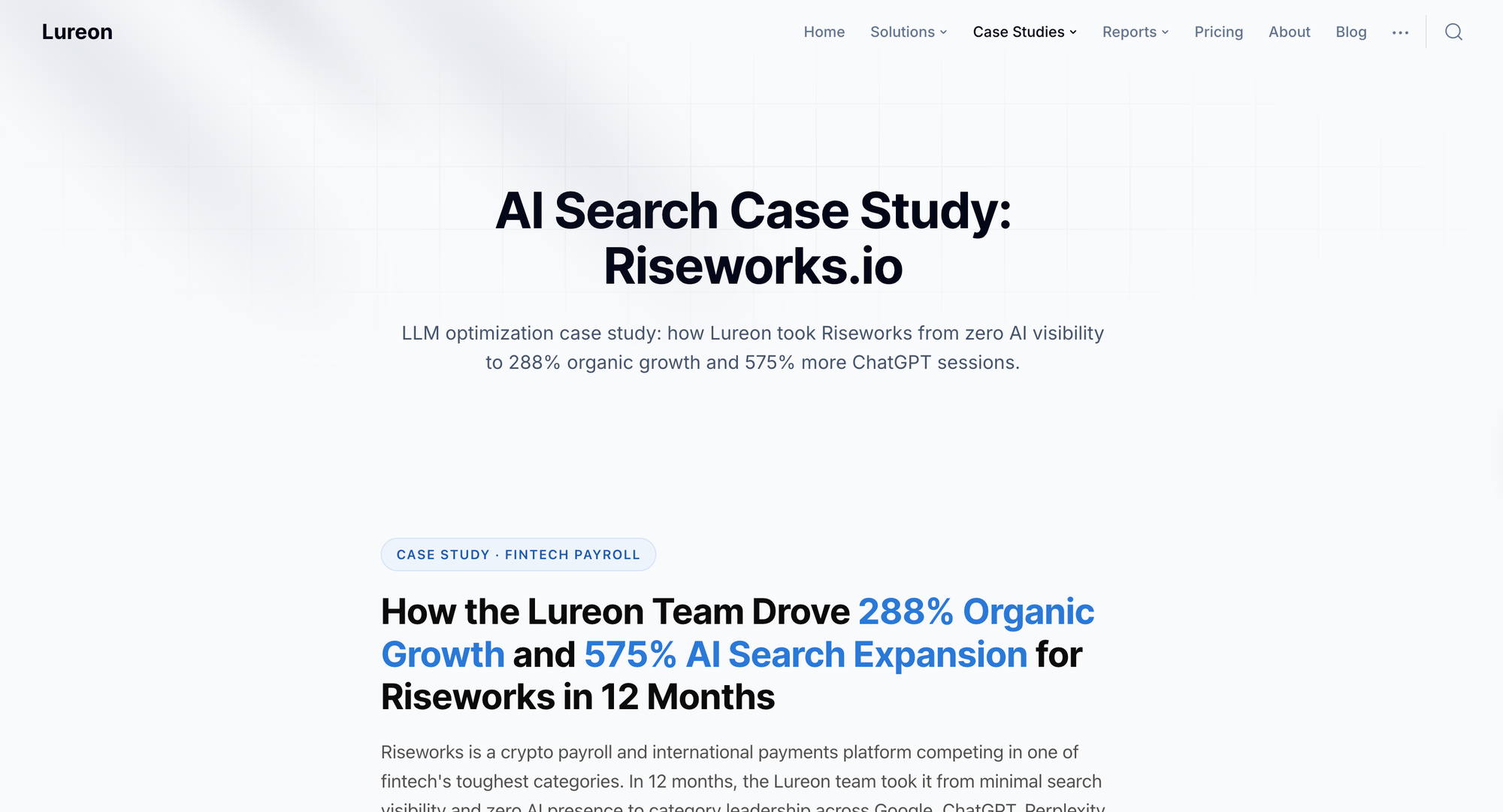
Those numbers are not remarkable because the tactics were novel. They are remarkable because the starting position in this sector is usually so far below where it should be that foundational work produces outsized movement.
The Check Worth Running Today
Three things, none of which require an agency.
- Confirm crawler access. Check whether GPTBot, OAI-SearchBot, ClaudeBot, PerplexityBot, and Google-Extended can reach your site, including through any WAF or bot protection layer. The robots.txt file is only half the answer.
- Fetch your key pages without JavaScript. If documentation and product pages render empty, models see the same thing.
- Ask a model about your protocol. Note whether the description matches your current positioning and which sources it cites. Outdated framing points to a specific correctable source.
If all three come back clean, your problem is corroboration rather than access, which is slower work and a different conversation. If any come back blocked, that is the cheapest visibility gain available to you and it does not require a budget cycle.
If you want a full read on which sources produce your answers and where the gap sits, that diagnostic is where Lureon starts.
FAQs
1. Why are crypto websites invisible in AI search?
Predominantly because of crawler blocking. Analysis of over 16,000 crypto prompts found 96% of crypto websites block AI crawlers, usually as a side effect of bot protection configured for security reasons rather than as a deliberate choice about AI visibility.
2. Why does AI search matter more for Web3 than other sectors?
Because the paid fallback is restricted. Google and Meta limit crypto advertising, so most projects cannot supplement organic visibility with paid acquisition the way SaaS companies can. That makes AI search a primary discovery channel rather than a supplementary one.
3. Is unblocking crawlers enough?
No. Many Web3 sites assemble content client-side, so a crawler with full access still receives an empty page. Check what your key pages render without JavaScript execution, since that is closer to what retrieval systems can actually use.
4. Why is my protocol described using old positioning?
Because the previous framing accumulated years of discussion while the current one has months, and third-party sources describing the old position were never updated. Correcting the specific sources producing that description usually works faster than publishing new material.
5. How long does Web3 AI visibility work take?
Access and rendering fixes can show movement within weeks. Entity consistency takes one to two months, source corrections two to three, and community presence plus independent coverage runs into quarters. The fast fixes are worth doing immediately regardless of the longer programme.
Figures reference published analysis of crypto AI citation patterns and platform advertising policies. Citation behaviour varies by subsector, and conditions in this category change more quickly than in most.