
AI Overviews now surface in roughly 48% of Google searches, up from 34.5% in December 2025. 93% of AI Mode sessions end without a single click to any website. If your brand isn't named inside the answer, there's no impression, no bounce rate, and no line item in Search Console to tell you the opportunity ever existed.
Our team at Lureon.ai runs this kind of audit for clients every week, and the pattern is consistent: a brand can rank #1 on Google and still be invisible the moment someone asks ChatGPT, Perplexity, Gemini, or Claude the exact same question. Traditional rank trackers were never built to see that gap. That's exactly why AI search visibility tracking has become its own discipline inside GEO.
Key Takeaways
- AI answers only surface 1 to 3 brands per response. Visibility is a mention rate across many prompts, not a ranking position.
- Each engine pulls from a different data source. ChatGPT leans on Bing plus training data, Perplexity crawls live, Gemini inherits Google's Knowledge Graph, and Claude relies on training-data consensus.
- Citations are stronger than mentions. A linked, cited source signals real trust; a bare name-drop from memory does not.
- Perplexity and ChatGPT's browsing mode shift weekly, while Claude's training-data-driven answers move far more slowly. Your tracking cadence should match each platform's actual refresh rate.
- Most brands don't track this at all, which means a basic prompt-testing habit is often enough to outpace competitors who are still flying blind.
Why AI Search Visibility Is a Different Problem Than SEO Rankings
Traditional SEO measures where a page sits in a list of ten blue links. AI search visibility measures whether your brand gets mentioned, cited, or recommended inside a generated answer, and most answers name only one to three brands total. That reshapes the entire objective from "rank higher" to "get chosen."
The four platforms don't share a scoring system, and they don't pull from the same data:
- ChatGPT blends training data with live Bing search results and browsing plugins. If Bing's index can't find a page, ChatGPT generally can't cite it in real time.
- Perplexity relies almost entirely on live web crawling, making it the most responsive engine to newly published or newly linked content.
- Gemini is tightly wired into Google's Knowledge Graph and Search index, so entity clarity, schema markup, and a well-maintained Google Business Profile carry outsized weight.
- Claude leans on training-data consensus, so third-party mentions that were present when the model was trained tend to matter more than what you published last week.
A single optimization playbook won't move all four dashboards equally. Tracking has to be platform-aware from the first prompt you write.
The Core Metrics to Track
Before opening any tool, define what "visible" actually means for your brand. Four metrics cover most of what matters:
1. Mention rate is the percentage of relevant prompts where your brand appears anywhere in the response. Mentioned in 18 of 60 test prompts means an 18/60 mention rate, the headline number for how often the model thinks of you at all.
2. Citation rate is how often the assistant links directly to your site as a source, rather than naming your brand from memory. This is the stronger signal, since it reflects the model treating your content as a verifiable source rather than a recalled fact.
3. Share of voice is your mention rate measured against named competitors on the same prompt set. A 20% mention rate looks strong until you see a competitor sitting at 70% on the same questions.
4. Sentiment and positioning captures whether the assistant actively recommends you, mentions you neutrally in a list, or points the user toward an alternative instead.
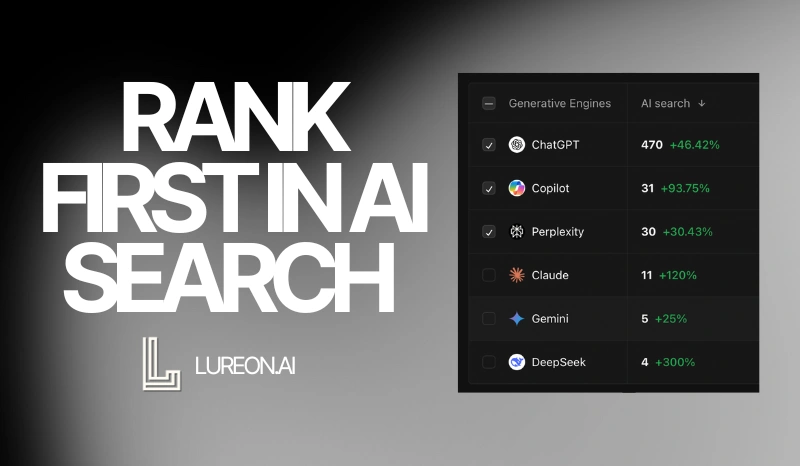
7 Steps to Track AI Search Visibility in 2026
1. Build a prompt set that mirrors real buyer language
The single biggest lever in visibility tracking is the prompt list itself. Build 20 to 50 prompts across four query types: informational ("What is X?"), commercial ("Best tools for X"), comparative ("X vs Y", "alternatives to Z"), and navigational ("What does [your brand] do?"). Write them the way a customer would actually type them, not the way you'd type a keyword into Google.
2. Run identical prompts across all four platforms
Test every prompt against ChatGPT, Perplexity, Gemini, and Claude using a fresh, logged-out or history-cleared session wherever the platform allows it. Personalization and prior chat history quietly skew results, so consistency across sessions matters more than convenience.
3. Log mentions and citations separately, not as one number
For each response, record whether your brand appeared at all, whether your URL was directly linked, where the mention sat in the response, which competitors appeared alongside you, and the overall tone. Collapsing "mentioned" and "cited" into a single metric hides exactly the gap you're trying to find.
4. Match your monitoring cadence to each platform's refresh rate
Perplexity and ChatGPT's browsing mode pull live web data, so weekly checks catch real movement. Gemini tracks closer to Google's own update rhythm, so bi-weekly to monthly is usually enough. Claude's training-data-driven answers shift the slowest, so monthly to quarterly monitoring is typically sufficient. Checking it weekly just produces noise.
5. Decide between manual tracking and a dedicated platform
Manual tracking costs nothing but time and works well for a first audit or a small prompt set. It also builds real intuition for how each model talks about your category. A wave of dedicated AI visibility platforms launched over the past year to automate this at scale, running recurring prompt sets across all four engines and benchmarking you against named competitors. Whichever you choose, weigh it against three questions: does it cover all four assistants, does it separate mentions from actual cited links, and does it connect the data to which of your pages are getting cited so you know what to reinforce.
6. Route findings back to the right platform-specific fix
A weak ChatGPT showing usually traces back to Bing indexing and structured data gaps. A weak Perplexity showing points to publishing cadence and the authority of sites linking to you. A weak Gemini showing points to Google Business Profile and schema cleanliness. A weak Claude showing points to a lack of durable, high-authority third-party mentions, the kind that tend to persist in training data rather than fade with a content refresh cycle.
7. Track the trend line, not just the snapshot
A single audit tells you where you stand today. The trend across four to eight weeks of consistent tracking tells you whether your GEO work is actually closing the gap, or whether a competitor is pulling ahead faster than you're catching up.
Avoiding Common Tracking Mistakes
Testing only branded prompts. Asking "what does [your brand] do?" tells you almost nothing about discovery. The prompts that matter are the ones a stranger to your brand would type: commercial and comparative queries where competitors are actively winning the mention.
Treating a mention and a citation as the same result. A brand name recalled from memory and a directly linked source reflect two different levels of trust. Reporting them as one number hides which platforms need a content fix versus a broader awareness push.
Checking once and calling it done. Perplexity and ChatGPT's live-crawled results can shift within weeks. A one-time audit is a useful baseline, not a strategy.
Ignoring session personalization. Logged-in sessions with chat history can quietly bias results toward brands you've already discussed. Fresh sessions give a cleaner read on what a new prospect would actually see.
How Lureon.ai Approaches AI Visibility Tracking
Most agencies still hand clients a single "AI visibility score" once a month and call it a strategy. We built our AI SEO and GEO services around the opposite premise: a score without a platform breakdown and a clear next action isn't actionable, it's just a number to feel anxious about.
We start with your actual buyer language, not a generic keyword list. Before we run a single prompt, we work with the client to build a prompt set of real informational, commercial, comparative, and navigational queries, the kind a prospect would type into ChatGPT or Perplexity while genuinely trying to solve a problem, not the kind an SEO tool would suggest by matching search volume.
We track mention rate and citation rate as two separate numbers, always. A client showing up by name in Claude but never getting linked as a source is a different problem than a client who's completely absent. Collapsing those into one visibility score hides which lever to pull, so our reporting keeps them apart from day one.
We match monitoring cadence to how each platform actually updates. Perplexity and ChatGPT's browsing mode get checked weekly, since both reflect live web changes almost immediately. Gemini tracking runs closer to Google's own update cycle. Claude gets checked monthly, since training-data-driven consensus doesn't move week to week, and checking it more often just adds noise to the report without adding signal.
We connect every gap to a specific fix, not a vague recommendation. If a client is invisible in ChatGPT, we check Bing indexing and structured data before touching anything else, since that's the actual bottleneck for that platform. If Gemini is the weak spot, we look at Google Business Profile completeness and schema coverage. If Claude is the gap, we look at where the durable, high-authority third-party mentions are missing, since that's what actually shifts training-data consensus over time. The report tells you what to do, not just where you stand.
We treat the trend line as the real deliverable. A single snapshot audit is useful once. What clients actually pay for is watching mention rate, citation rate, and share of voice move over four, eight, and twelve weeks as the underlying content and technical fixes take effect, and knowing whether a competitor is closing the gap faster than we are.
This is the same framework covered in this guide, run consistently across every client account rather than as a one-time audit.
Conclusion
AI search visibility isn't a vanity metric. For a growing share of buyer journeys, it's the only impression your brand gets before a decision is made. Tracking it properly means treating ChatGPT, Perplexity, Gemini, and Claude as four distinct channels with four distinct data sources, running a consistent prompt set against all of them, and separating a bare mention from a real, linkable citation.
Most brands still aren't measuring any of this. A basic prompt-testing habit, run consistently, is often enough to see gaps competitors haven't found yet.
FAQs
1. How is AI search visibility different from a Google ranking?
A Google ranking is a position in a list of links. AI visibility is whether your brand gets mentioned or cited inside a generated answer that typically names only one to three brands total. There's no "position #1" to track, only a mention rate across many prompts.
2. What's the difference between a mention and a citation?
A mention is your brand name appearing anywhere in the response, recalled from the model's training or general knowledge. A citation is the assistant linking directly to your site as a source. Citations are the stronger trust signal and the better indicator that your content itself is working.
3. How often should I check my AI visibility?
Match the cadence to the platform. Perplexity and ChatGPT's browsing mode pull live data, so weekly checks are worthwhile. Gemini moves on a slower rhythm tied to Google's own updates. Claude's training-data-driven answers shift the slowest, so monthly or quarterly checks are usually sufficient.
4. Do I need a dedicated tool, or can I track this manually?
Manual tracking with a fixed prompt set works fine for a first audit or a small brand. It becomes hard to sustain once you're testing 50+ prompts across four platforms and multiple competitors on a recurring schedule. That's where dedicated AI visibility platforms earn their cost.
5. Which platform should I prioritize first?
Whichever one your buyers are most likely to be using for research in your category. If you're unsure, run the same prompt set across all four first. The audit itself usually makes the priority obvious.