
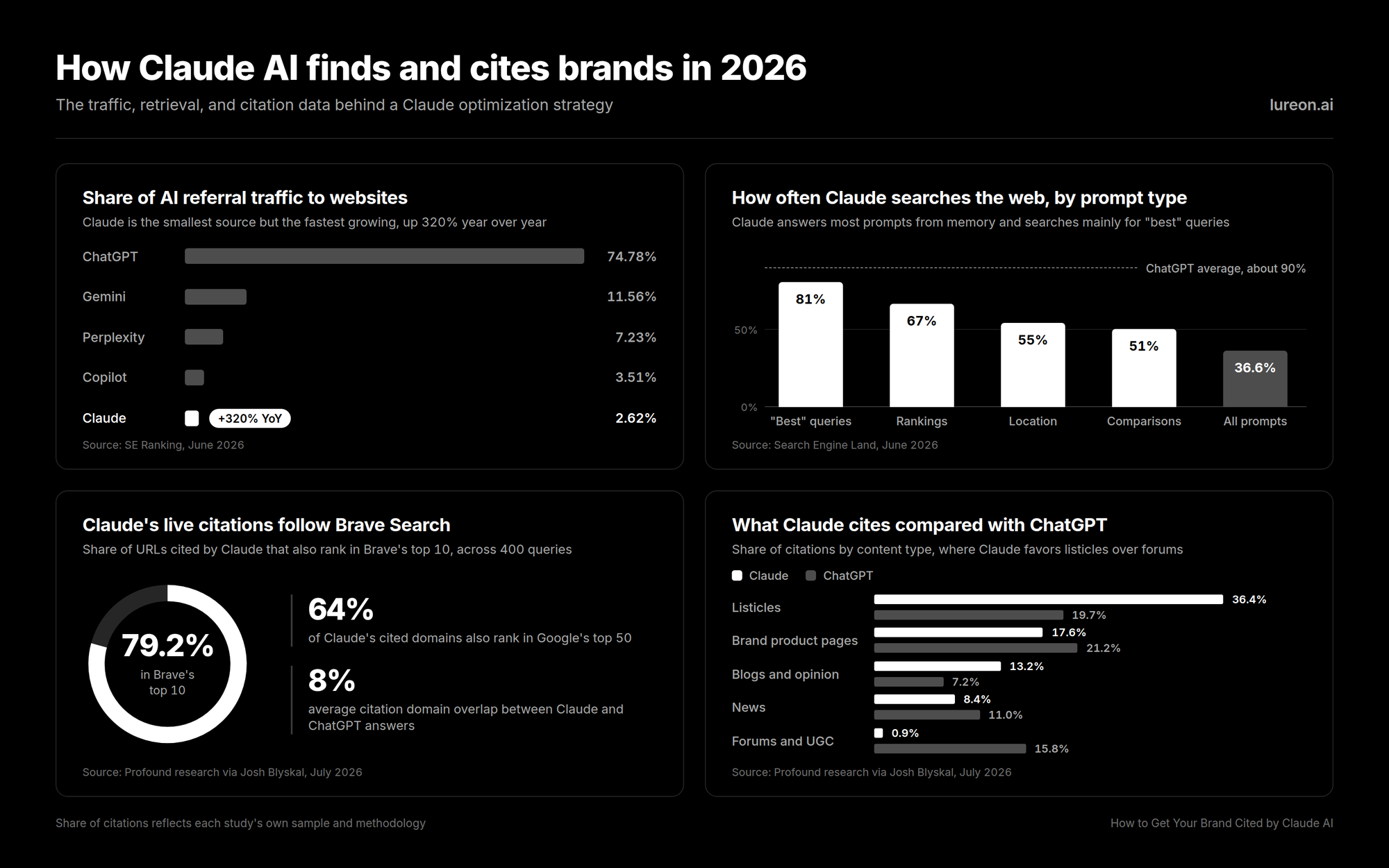
Claude referral traffic to websites grew 320% year over year in 2026, the fastest growth of any major AI platform (source: SE Ranking).
At Lureon, we build AI search visibility programs that turn Claude, ChatGPT, Perplexity, and Gemini into measurable pipeline, and Claude now gets its own dedicated playbook in that work.
Claude does not behave like Google or ChatGPT: it answers most questions from training memory, reaches for the live web only on certain prompt types, and pulls those live results through Brave Search instead of Google's index.
This guide walks you through the full step-by-step process for getting your brand cited by Claude AI, from crawler access and Brave rankings to content structure, third-party proof, and citation tracking.
Key Takeaways
- Claude answers most prompts from memory and searches mainly for "best" and comparison queries.
- Claude's live citations closely track Brave Search's top 10 results, not only Google.
- Brand-owned reference pages and listicles win Claude citations; Reddit barely registers.
- Allow Claude-SearchBot, Claude-User, and Googlebot, or Claude cannot retrieve your pages.
- Refresh priority pages monthly and track citations with scheduled prompt testing.
Why Claude Became a Citation Channel Worth Optimizing For in 2026
Claude is still a small referral source in absolute terms, but it is the fastest-moving one.
ChatGPT sends 74.78% of AI referral traffic to websites while Claude sends 2.62%, and Claude's worldwide traffic share jumped 159% in March 2026 alone (source: SE Ranking).
That same month, Claude passed Perplexity in monthly referral sessions for the first time and has stayed ahead since (source: Previsible).
The audience behind those clicks is large and commercially valuable.
Claude.ai recorded roughly 946.7 million visits in June 2026 and held an 8.9% share of AI chatbot traffic in May (source: Gradually AI).
More than 300,000 businesses use Claude, and 70% of Fortune 100 companies are customers (source: DataRefs).
Traffic quality is where Claude stands out.
Across 218 client websites, Claude produced the strongest lead-to-customer rate of any AI platform at 22.6%, with the longest sessions at 6 minutes 41 seconds (source: First Page Sage).
If you are weighing where to invest first, our guide on choosing which AI platform to optimize for first covers the trade-offs.
How B2B Buyers Use Claude to Build Vendor Shortlists
Vendor shortlists are now formed inside AI answers before a buyer ever visits your website.
Half of B2B software buyers (51%) start their research with an AI chatbot more often than with Google, up from 29% in 2025 (source: G2).
Sixty-nine percent chose a different vendor than they originally planned based on AI chatbot guidance, and one-third bought from a vendor they had never heard of before (source: PR Newswire).
The top use case is exactly the kind of work Claude is trusted for.
Comparing vendor strengths and weaknesses leads all AI research tasks at 41% (source: Demand Gen Report), and 82% of buyers sourced software recommendations from an AI chatbot in the last two years (source: PR Newswire).
For a brand, the practical implication is simple: if Claude does not name you when a buyer asks for options, you are not on the shortlist.
Lureon's Claude AI Visibility Report breaks down the demand side in more detail.
How Claude Decides What to Cite
Claude builds every answer from three layers, and each one needs a different optimization approach;
- Parametric memory: What Claude learned about your brand and category during training. This layer answers every prompt that does not trigger a search.
- Live retrieval: When Claude searches, it pulls candidate pages from Brave Search. Anthropic added Brave to its subprocessor list on March 19, 2025, and listed a second web search provider, turbopuffer, on May 6, 2026 (source: Xponent21).
- Extraction: Once a page is retrieved, Claude keeps only the passages it can quote cleanly and attribute with confidence.
The first gate is whether Claude searches at all. Claude used web search on 36.6% of prompts, compared with about 90% for ChatGPT (source: Search Engine Land).
The prompt type decides the route:
| Prompt type | Example | Claude web search rate |
|---|---|---|
| Recency ("best") | "Best CRM for startups" | 81% |
| Ranking | "Top payroll platforms" | 67% |
| Location | "GEO agency near me" | 55% |
| Comparison | "HubSpot vs Salesforce" | 51% |
| Informational | "What is AEO?" | Mostly answered from memory |
(source: Search Engine Land)
When Claude does search, Brave rankings carry most of the weight.
Across roughly 35,000 URLs tied to 400 queries, 79.2% of Claude's cited URLs also appeared in Brave's top 10, while Claude's cited domains overlapped with Google's top 50 results 64% of the time (source: Josh Blyskal).
Claude and ChatGPT shared only 8% of citation domains on average, which is why a single "AI SEO" playbook fails, a pattern we explored in our analysis of which domains AI engines trust most.
What Claude Actually Cites
Claude's source mix looks very different from other engines.
In an analysis of 379,321 Claude citations across 16,406 domains, brand and product websites earned 64.0% of all citations, news and media earned 14.9%, and social media earned just 0.9%, with Reddit cited zero times (source: OtterlyAI).
The top 10 domains held only 9.5% of citations, and 32.9% of cited domains appeared just once, so smaller brands can realistically win.
| Content type | Claude share of citations | ChatGPT share of citations |
|---|---|---|
| Listicles | 36.4% | 19.7% |
| Brand product pages | 17.6% | 21.2% |
| Blogs and opinion | 13.2% | 7.2% |
| News | 8.4% | 11.0% |
| Forums and UGC | 0.9% | 15.8% |
(source: Josh Blyskal)
Claude also leans more on owned content than its rivals. Claude gives 53% of citations to owned and other content versus 43.1% to earned media, while ChatGPT gives earned media 51.1% (source: AuthorityTech).
Your own website is your highest-leverage asset for Claude, which is the opposite of the Reddit-first approach that works on Perplexity.
Step-by-Step: How to Get Your Brand Cited by Claude AI
Step 1: Open Crawler Access for Claude and Brave
Anthropic documents three separate bots, each with its own robots.txt user agent:
- ClaudeBot for training
- Claude-User for fetching pages when users ask questions
- Claude-SearchBot for search indexing (source: Search Engine Journal).
Anthropic states that blocking Claude-SearchBot may reduce your visibility in user search results (source: Anthropic).
Brave adds one more dependency: its crawler has no distinct user agent and will not crawl a page that Googlebot cannot crawl (source: Brave).
A minimal configuration looks like this:
User-agent: Claude-SearchBot
Allow: /

User-agent: Claude-User
Allow: /

User-agent: ClaudeBot
Allow: /

User-agent: Googlebot
Allow: /
Allowing ClaudeBot feeds the memory layer, so block it only if your legal policy requires it.
Then confirm your firewall or CDN is not challenging these bots, since a 403 or interstitial kills the citation.
Our crawler configuration guide covers the full setup.
Step 2: Get Indexed and Ranking in Brave Search
Brave runs an independent index of 40 billion pages and adds or refreshes more than 100 million pages each day (source: Brave).
Search your priority category terms at search.brave.com, note where you rank, and submit key URLs through Brave's Submit URL page.
Treat Brave top 10 positions as your leading indicator for Claude retrieval.
Step 3: Map the Prompts That Trigger Claude Search
Build a list of 30 to 50 buyer prompts that include "best," "top," "vs," a location, or the current year.
Claude added "2026" or "2025" to 94% of its search fan-outs, compared with 17% for ChatGPT, and adding the year to a page title made it 17% more similar to Claude's generated queries (source: Josh Blyskal).
Put the year in titles and H1s wherever the answer genuinely changes over time.
Our walkthrough on running a citation study shows how to structure this prompt set.
Step 4: Write Answer-First, Extractable Sections
Open every section with a 40 to 60 word direct answer under a question-shaped heading, then support it with dated statistics and named sources.
Adding statistics, quotations, and citations lifted generative engine visibility by up to roughly 40% in peer-reviewed testing (source: arXiv).
Make each section readable on its own by naming the subject instead of relying on pronouns, since restoring context to isolated chunks cut failed retrievals by 49% in Anthropic's own testing (source: Anthropic).
Writing in the language your customers actually use makes those passages match real prompts.
Step 5: Publish Listicles, Comparisons, and Reference-Grade Pages
Because listicles earn more than a third of Claude's citations, build ranked "best X for Y" pages, honest "X vs Y" comparisons, and product pages that read like documentation rather than brochures.
Cover every adjacent question in your category with its own focused page, because Claude spreads citations across a long tail of domains.
This is also how you avoid the trap we describe in why AI cites the explainer, not you.
Step 6: Earn Specialist Coverage and Reviews
Claude checks claims against outside sources before it recommends a brand.
Claude's reliance on reviews and social proof runs two to four times higher than competing models across every sector measured (source: Yext).
Prioritize review platforms, category directories, specialist trade publications, and co-published case studies over general press.
Unlinked mentions count too, as we explain in backlinks vs unlinked brand mentions.
Step 7: Lock Your Entity Data and Schema
Use an identical company name, description, category, and founding details on your site, LinkedIn, directories, and review profiles.
Add Organization, FAQPage, Article, and ItemList schema so Claude can read the story in a machine-readable format.
A dedicated structured data page for LLMs gives Claude one canonical source of facts to confirm.
Step 8: Refresh Priority Pages on a Fixed Cadence
In Lureon's client tracking, 76% of AI citations come from content updated in the last 30 days, and the median AI citation drops out of answers within about 4.5 weeks (source: Lureon).
Refresh commercial and comparison pages monthly with real new data, then sync the visible "last updated" line, dateModified schema, and sitemap lastmod.
Cosmetic date changes without new content do not hold.
Step 9: Track Claude Citations and Referrals
Create a custom GA4 channel group that captures claude.ai referrals, run your prompt list in Claude on a fixed schedule, and log whether you are named, where you appear, and which competitors are cited.
Track Brave rankings alongside it.
Our guide on tracking AI search visibility covers the tooling across all four major engines.
What a Claude Citation Program Costs in 2026
Most brands choose between hiring in-house, training an existing SEO, or working with a specialist agency.
Advertised AEO and GEO pay ranges from $75,000 to $95,000 for a specialist, $100,000 to $174,000 for an enterprise AEO and SEO manager, and $150,000 to $210,000 for senior AI-focused content roles (source: Sloane Staffing).
At the manager level, Citizens Bank advertised an Answer Engine Optimization Manager role at $131,000 to $171,000 plus bonus (source: Hire Lanz).
| Option | Typical annual cost | Best fit |
|---|---|---|
| GEO/AEO specialist hire | $75,000 to $95,000 | Mid-size teams with content resources |
| Enterprise AEO/SEO manager | $100,000 to $174,000 | Large brands with multiple product lines |
| Specialist agency | See Lureon pricing | Teams that need senior execution without new headcount |
(source: Sloane Staffing)
Demand is rising fast: 94% of enterprise CMOs plan to increase AEO and GEO investment in 2026 (source: Sloane Staffing).
For a full budget breakdown, see our guide to what GEO costs in 2026.
On timing, expect meaningful citation movement within 60 to 120 days, with crawler and freshness fixes producing the earliest wins (source: Lureon).
Our post on what GEO looks like after the first 90 days sets realistic expectations.
Common Mistakes That Keep Brands Out of Claude Answers
- Porting a Reddit-first playbook: Reddit dominates Perplexity and ChatGPT citations, but Claude barely cites forums. Effort spent there does little for Claude.
- Blocking the wrong bot: Many sites block ClaudeBot and accidentally block Claude-SearchBot or Googlebot through broad firewall rules, which removes them from Claude retrieval entirely.
- Optimizing only for Google rank: Google rankings help, but Brave is the index Claude actually queries. A page on Google's first page can still be invisible on Brave.
- Relying on the homepage: Claude prefers deep, focused pages and listicles. A single homepage cannot match the range of prompts buyers ask.
- Ignoring the memory layer: About two-thirds of Claude answers never trigger a search (source: Josh Blyskal). Consistent third-party coverage over months is the only way to shape what Claude already knows about you.
Conclusion
Getting cited by Claude AI comes down to understanding its three layers:
- Shape what it remembers through consistent coverage
- Win live retrieval through Brave rankings and open crawler access
- Earn the final citation with answer-first, well-sourced, regularly refreshed pages.
Brands that follow these nine steps and track results against real buyer prompts can move from invisible to shortlisted while the Claude channel is still wide open.
Read Next
- Backlinks vs. Unlinked Brand Mentions
- Best GEO Tools That Provide Third-Party Citations in 2026
- Should You Ask Your SEO Agency to Do GEO?
FAQs
1. How do you get your brand cited by Claude AI?
You get your brand cited by Claude AI by allowing Claude-SearchBot, Claude-User, and Googlebot to crawl your site, ranking in Brave Search's top 10 for buyer prompts, and publishing answer-first pages with dated, sourced statistics. Consistent entity data, specialist third-party coverage, and monthly refreshes on priority pages complete the process.
2. Does Claude use Google or Brave Search to find sources?
Claude uses Brave Search to find sources when it searches the live web, and Anthropic lists Brave as a web search subprocessor. Research shows 79.2% of Claude's cited URLs also appear in Brave's top 10 (source: Josh Blyskal). Google still matters indirectly, because Brave will not crawl pages that Googlebot cannot access.
3. How long does it take to get cited by Claude AI?
It takes roughly 60 to 120 days to get cited by Claude AI consistently, depending on your starting authority and category competition (source: Lureon). Crawler fixes, Brave indexing, and content refreshes can produce early citations within 30 days, while shaping Claude's trained memory of your brand takes several months.
4. Which Claude crawlers should I allow in robots.txt?
The Claude crawlers you should allow in robots.txt are Claude-SearchBot and Claude-User at a minimum, since they control search indexing and user-requested page fetches. Allowing ClaudeBot as well lets your content inform future Claude models, which strengthens the memory layer that answers prompts without a live search.
5. What type of content does Claude cite most often?
The type of content Claude cites most often is brand-owned reference content, especially listicles, comparison pages, and detailed product pages. Listicles earn 36.4% of Claude's classified citations, while forums and user-generated content earn under 1% (source: Josh Blyskal), so focused, well-structured pages on your own domain outperform social and community posts.
This guide explains how Claude AI chooses which brands to cite, from what it remembers through training to the pages it retrieves through Brave Search and the passages it finally quotes. It walks through nine practical steps covering crawler access, Brave rankings, answer-first content, third-party proof, entity data, content refreshes, and citation tracking, backed by 2026 data on Claude's traffic growth, source preferences, and buyer behavior. The goal is to give marketing teams a clear, repeatable process for turning Claude into a measurable source of brand visibility and qualified pipeline.