
Ask the same question on Perplexity and ChatGPT, and you will often get two completely different sets of sources. That is not a bug in one of the two systems. It is a sign that they are solving different problems, and that a single "AI SEO" playbook cannot win both.
Most GEO advice treats AI search as one undifferentiated target. Get structured, get authoritative, get cited, repeat. That framing breaks down fast once you look closely at Perplexity, which retrieves the live web on every single query, leans on community sources like Reddit far more than any other major engine, and shows its citations openly enough that anyone can verify exactly why it chose a source.
Perplexity now handles tens of millions of queries a day and has crossed 230 million monthly active users in early 2026, putting it firmly alongside ChatGPT and Google's AI features as a primary discovery surface. At Lureon, we treat it as its own optimization target, not a smaller version of ChatGPT work. This guide breaks down how Perplexity actually selects sources, where it structurally diverges from the other two engines, and what to do differently to earn a place in its answers.
Key Takeaways
- Perplexity retrieves live, unlike ChatGPT's reliance on frozen training data.
- Reddit and community threads carry outsized weight in Perplexity's citations.
- Freshness is the second-strongest signal, after topical relevance itself.
- Cross-platform overlap is low: few domains get cited by both Perplexity and ChatGPT.
- Access is contested: Perplexity's crawler behavior has drawn real scrutiny.
Why Perplexity Doesn't Play by Google's Rules, or ChatGPT's
Google ranks pages and hands you a results list. ChatGPT answers largely from parametric knowledge baked in during training, refreshed periodically and supplemented with browsing when needed. Perplexity does neither.
Every Perplexity query triggers a live retrieval-augmented generation pipeline: it searches the current web, pulls a set of candidate pages, and only then writes an answer grounded in what it just retrieved. This means a well-structured article published this morning can appear in a Perplexity citation within hours, with no need to wait for a model retrain or a search index refresh cycle. It also means the reverse is true: content that was accurate and well-cited a year ago can quietly drop out of rotation the moment a fresher, equally relevant page appears.
The practical result is that Perplexity optimization is closer to earning a citation in a living reference than to ranking in a static list. You are not competing for position ten versus position one. You are competing to be one of the handful of sources the model's synthesis step decides it can quote without distortion.
Inside Perplexity's Citation Pipeline
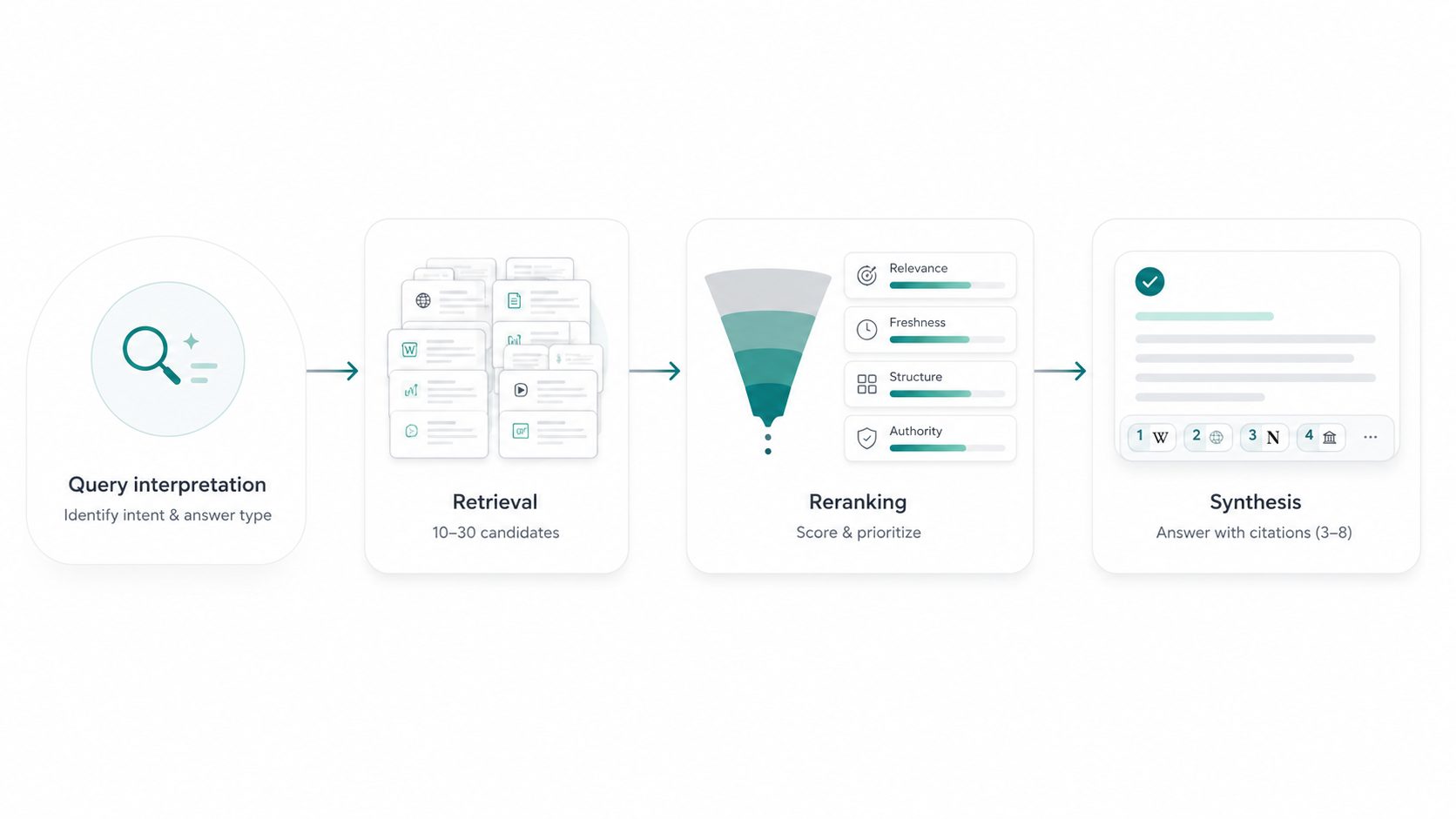
Perplexity's exact internal weighting is proprietary, but the shape of the pipeline is well documented and consistent across independent analyses. Understanding each stage matters because a page can fail for a different reason at each one.
- Query interpretation. Perplexity parses intent, decides whether the question needs fresh information, and classifies the expected answer type: a definition, a comparison, a list, or a current event.
- Retrieval. The system pulls a batch of candidate pages, typically somewhere between ten and thirty, from its own index (built by PerplexityBot) plus supplementary sources for long-tail queries.
- Reranking. A multi-layer system, generally described as three passes, scores those candidates on relevance, freshness, entity clarity, structural quality, and authority signals.
- Synthesis. Only three to eight of the reranked candidates make it into the final answer, and the language model is constrained to quote only what it can attribute cleanly, without distorting the source.
That last constraint is the one most content misses. A page can be topically perfect and still get filtered out at the synthesis stage if its key claim is buried in the fourth paragraph, hedged in vague language, or split across two sentences that don't attribute cleanly to a single fact. Front-loading the direct answer, then supporting it immediately below, consistently outperforms a build-up structure written for human patience.
Perplexity vs. ChatGPT vs. Google, Side by Side
| Dimension | Perplexity | ChatGPT | Google AI Overviews |
|---|---|---|---|
| Source of truth | Live web, every query | Training data, plus browsing when triggered | Google's core Search index |
| Dominant sources | Reddit, news, reference sites | Wikipedia, established publications | Existing top-ranking pages |
| Freshness sensitivity | Very high | Moderate | Tied to normal crawl cycles |
| Citations shown | Always, 3 to 8 per answer | Only when browsing is used | Linked source cards |
| Optimization target | Extractable, current, community-verified facts | Consensus, broad recognition | Classic SEO ranking factors |
The overlap between these three is smaller than most teams assume. Research comparing citation behavior across all three engines for the same prompts consistently finds that only a small fraction of domains get cited by more than one platform for identical queries. Ranking well on Google is a reasonable starting point for AI visibility generally, as we've covered when calculating GEO ROI, but it is not a proxy for a Perplexity citation specifically.
Get started with a Perplexity-specific visibility audit if you're not sure where you currently stand.
Focus Modes and Perplexity's Expanding Surface Area
One technical detail changes the comparison table above depending on context: Perplexity's Focus Modes act as hard filters at the retrieval stage, not a cosmetic toggle. Selecting Academic mode over the default Web mode swaps out the entire candidate pool before ranking even begins, pulling from peer-reviewed sources instead of the open web.
This matters most for regulated or research-adjacent industries. A healthcare or fintech brand optimizing purely for Web mode citations may be invisible in Academic mode for the exact same query, and vice versa. Before investing heavily in one strategy, check which mode your target audience actually defaults to for the topics you're trying to own, since the two source pools barely overlap.
Perplexity's footprint is also expanding beyond the standalone search box in ways worth tracking. Comet, the company's own Chromium-based browser, launched to top-tier subscribers in mid-2025 and rolled out free and worldwide by early 2026, embedding a sidecar assistant directly into everyday browsing rather than confining citations to a dedicated search query. Practically, this means a page that earns a Perplexity citation increasingly surfaces to people mid-browse, not only to people who opened Perplexity with a specific question in mind.
On the model side, Perplexity's default answers run on its own in-house Sonar family, tuned specifically for search-grounded responses, though paid tiers let users switch to frontier models from other labs for the underlying generation step. This choice affects writing style and reasoning depth, but the retrieval and citation layer around it stays Perplexity's regardless of which model a user selects, which is why the optimization guidance in this article holds across tiers.
Why Reddit Carries So Much Weight Here
This is the single most distinctive fact about Perplexity, and the one most SEO playbooks ignore entirely. Independent citation studies place Reddit's share of top Perplexity citations well above what any other single domain type earns, and it shows up constantly in comparison, recommendation, and "best of" style queries specifically.
The mechanism makes sense once you think about what Perplexity is trying to solve. For subjective or experience-based questions, a Reddit thread with genuine back-and-forth discussion often contains more verifiable, specific, first-hand detail than a polished brand page ever will. Perplexity's reranking layer rewards exactly that kind of extractable, concrete claim over generic marketing language.
This has one important, non-negotiable implication for anyone tempted to shortcut it. Astroturfed threads and planted reviews get caught, both by the communities themselves and by the same quality signals that reward genuine participation, and the reputational damage from being caught can outlast whatever short-term visibility it bought. Authentic participation in the subreddits your buyers already use is the actual leverage point, not a workaround to fake it.

The Technical Side: PerplexityBot, Robots.txt, and Access
Access is the precondition for everything above. PerplexityBot is Perplexity's sole crawler, a pure retrieval bot with no separate training counterpart, and blocking it in robots.txt removes a site from Perplexity's citation pool entirely.
Perplexity's own compliance with robots.txt has been genuinely contested, which matters if you are deciding how much to trust an access rule as a control. In January 2026, Cloudflare published findings describing Perplexity crawlers that rotated IP addresses and spoofed a standard browser user agent after being blocked, behavior serious enough that Cloudflare removed Perplexity from its verified bot list. Perplexity disputed the characterization, arguing that its user-triggered agents function more like a browser fetching a page on a person's behalf than a bulk scraper, and that the flagged traffic did not originate from its declared crawler.
Whichever account you find more persuasive, the practical takeaway is the same: a robots.txt rule is a request, not a lock, and if PerplexityBot traffic matters to your visibility, verify it in server logs rather than assuming a Disallow line settles the question. Our crawler configuration guide covers how to set this up correctly alongside the other major AI bots.
Paywalled and gated content adds another wrinkle. Standard Perplexity users cannot access paywalled sources at all, and when a page is blocked this way, the model falls back to whatever alternative sources it can reach, typically producing a less specific answer. Pro and Max subscribers gained access to select premium partnerships in 2026, including sources like PitchBook and CB Insights, but that tier sits well above what most sites need to plan around.
A Worked Example
Consider a B2B SaaS company selling project management software for remote teams, targeting the query "best project management tool for remote teams."
Their existing blog post ranked reasonably well on Google, but audit logs showed zero Perplexity citations for that exact query over a 60-day window. The page opened with three paragraphs of company background before addressing the question at all, buried its feature comparison in a table with no surrounding prose Perplexity could extract cleanly, and hadn't been updated in fourteen months.
The fix followed the pipeline logic directly. The page was restructured to answer the query in its first two sentences, the comparison table was rebuilt with a plain-language summary sentence above it stating the actual recommendation, and the content was refreshed with current pricing and a genuinely new observation about async workflows rather than a cosmetic date change. The team also began participating, transparently and under their own identity, in two relevant subreddits where the exact buying question came up organically.
Within roughly six weeks, the page began appearing in Perplexity answers for that query and several adjacent ones, alongside the subreddit threads the team had participated in. Neither change alone would likely have moved the needle. It was the combination of extractable on-page structure and genuine off-site presence in the sources Perplexity already trusts for that query type.
Step-by-Step Playbook to Get Cited by Perplexity
- Lead with the direct answer. State the conclusion in the first one to two sentences, then support it below. Perplexity's synthesis stage pulls from the first clean, attributable claim it finds.
- Name entities exactly. Use the precise product, company, or concept name rather than a synonym or vague reference, since entity clarity is an explicit checkpoint in the reranking layer.
- Date your claims. Put specific dates near any time-sensitive fact, and treat quarterly, substantive refreshes as standard maintenance, not a one-time project.
- Structure for extraction. Definitions, numbered comparisons, and clear procedural steps survive the reranker better than long, undifferentiated prose blocks.
- Show up in the right communities, honestly. Identify two or three subreddits or forums where your actual buyers already ask the question you want to be cited for, and participate as yourself.
- Build topical breadth, not just one page. A cluster of pages answering every adjacent question a buyer might ask gets surfaced across more query variations than a single, deeper page.
- Verify crawler access directly. Confirm PerplexityBot requests in server logs rather than trusting a robots.txt rule alone, given the access disputes covered above.
How This Differs by Business Type
B2B SaaS and services
Comparison and "best of" queries dominate this category, which means Reddit and community forums matter more here than almost anywhere else. Prioritize genuine participation in the specific subreddits your buyers already use over publishing another comparison page nobody outside your own site links to.
E-commerce
Perplexity shows the lowest rate of citing broken or unavailable pages of any major AI engine, which makes basic link hygiene a real ranking factor, not just good practice. Keep product data current, since stale pricing or discontinued items get filtered at the freshness stage before authority even becomes relevant.
Fintech and research-heavy industries
Premium source partnerships mean some of your competitive citation landscape sits behind Perplexity's paid tier, inaccessible to free users entirely. Focus on becoming the clearest, most current open-access explainer for your specific niche, since that is the layer most users actually see.
Content publishers
Homepages and evergreen reference pages get cited more often here than on other engines, rewarding strong brand-entity signals over purely long-tail landing pages. Pair that strength with a disciplined refresh schedule, since Perplexity drops stale pages from rotation faster than Google demotes them.
Common Mistakes That Keep You Out of Perplexity Answers
Treating your own website as sufficient
Ignoring community platforms entirely is the single most common gap. A page can be perfectly optimized and still lose to a Reddit thread that simply contains more specific, verifiable detail.
Faking community presence
Astroturfing gets caught by both the community and Perplexity's own quality signals, and the damage compounds once a brand is flagged as inauthentic in a space it needs credibility in.
Cosmetic freshness updates
Changing a published date without adding real value doesn't fool the freshness signal for long, and pages that keep doing it tend to lose trust faster than ones that never update at all.
Writing for patience instead of extraction
Long introductions before the actual answer work against you here in a way they don't necessarily hurt traditional SEO, since Perplexity's synthesis stage favors the first clean, attributable claim it can find.
Verifying and Tracking Perplexity Citations
Configuration without verification is a guess, so three checks confirm whether the work above is actually landing.
Check server logs directly for PerplexityBot requests, ideally verified against Perplexity's published IP ranges rather than the user-agent string alone, given the access disputes covered earlier. Track referral traffic from perplexity.ai separately from general organic traffic in analytics. Run your own target queries in Perplexity on a regular cadence and log which sources appear, since this is the most direct way to see how you compare against competitors for the exact prompts your buyers use.
For a broader system that tracks this alongside ChatGPT, Claude, and Gemini in one place, see our guide on tracking AI search visibility.
Conclusion
Perplexity rewards a different set of signals than Google or ChatGPT: live freshness over indexed permanence, extractable clarity over polished marketing copy, and genuine community presence over on-site authority alone. Treating it as a smaller version of your ChatGPT strategy leaves real citations on the table, particularly for comparison and recommendation queries where Reddit routinely outperforms brand-owned content.
Start with the access layer, confirm PerplexityBot can actually reach your pages, then restructure your highest-intent content to lead with the answer instead of the setup. The community piece takes longer to build than a technical fix, but it is where most of the durable advantage in this specific engine actually sits.
If you'd rather have this audited and built for you, get started with Lureon.
FAQs
1. Does ranking well on Google guarantee a Perplexity citation?
No. Research comparing citation overlap across engines consistently finds that only a small share of domains get cited by both Perplexity and Google's AI features for the same query, since each system weighs different signals.
2. How often does Perplexity content need to be refreshed?
Quarterly, substantive updates are a reasonable baseline, and pages that already earn citations tend to see a faster lift from a refresh than brand-new pages starting from zero. Cosmetic date changes without real new content don't hold up under the freshness signal for long.
3. Is participating in Reddit actually worth the effort for a B2B brand?
For comparison and recommendation queries specifically, yes, since Reddit accounts for a disproportionate share of Perplexity's top citations in that category. The requirement is genuine, identifiable participation, not promotional posting disguised as organic discussion.
4. Can I trust robots.txt alone to control whether Perplexity accesses my site?
Not fully. Cloudflare has documented Perplexity crawler behavior that appeared to circumvent robots.txt blocks, a finding Perplexity disputes, so anything that must stay fully inaccessible needs server-level enforcement as a backup.
5. Does Perplexity favor long-form or short-form content?
Neither format wins outright. What matters is whether the specific claim being cited is stated clearly and attributably within a paragraph or two, regardless of the total page length around it.